
Bi
Bismuthum
BISMUTH
NITROGEN GROUP
| Atomic number: | 83 |
| Group numbers: | 15 |
| Period: | 6 |
| Electronic configuration: | [Xe] 4f14 5d10 6s2 6p3 |
| Formal oxidation number: | +3 +5 |
| Electronegativities: | 1.9 |
| Atomic radius / pm: | 154.5 |
| Relative atomic mass: | 208.980 40(1) |
Bismuth was discovered by Basil Valentine (DE) in 1450. The origin of the name comes from the German words Weisse Masse meaning white mass; now spelled wismut and bisemutum. It is a hard, brittle, steel-grey metal with a pink tint. It is stable in oxygen and water but dissolves in concentrated nitric acid. Bismuth can be found free in nature and in minerals like bismuthine (Bi2S3) and in bismuth ochre (Bi2O3) Main use is in pharmaceuticals and low melting point alloys used as fuses. The price of 99.99 % pure bismuth pieces is 110.20 € for 1000 g.
| Density / g dm-3: | 9747 | (293 K) |
| 10050 | (m.p.) | |
| Molar volume / cm3mol-1: | 21.44 | (293 K) |
| 20.79 | (m.p.) | |
| Electrical resistivity / µΩcm: | 106.8 | (20 °C) |
| Thermal conductivity / W m-1K-1: | 7.87 |
| Melting point / °C: | 271.4 |
| Boiling point / °C: | 1564 |
| Heat of fusion / kJ mol-1: | 10.48 |
| Heat of vaporization / kJ mol-1: | 179.1 |
| Heat of atomization / kJ mol-1: | 207.36 |
| First ionization energy / kJ mol-1: | 702.96 |
| Second ionization energy / kJ mol-1: | 1610.35 |
| Third ionization energy / kJ mol-1: | 2466.18 |
| in the atmosphere / ppm: | - |
| in the Earth's crust / ppm: | 0.06 |
| in the oceans / ppm: | 0.0002 |
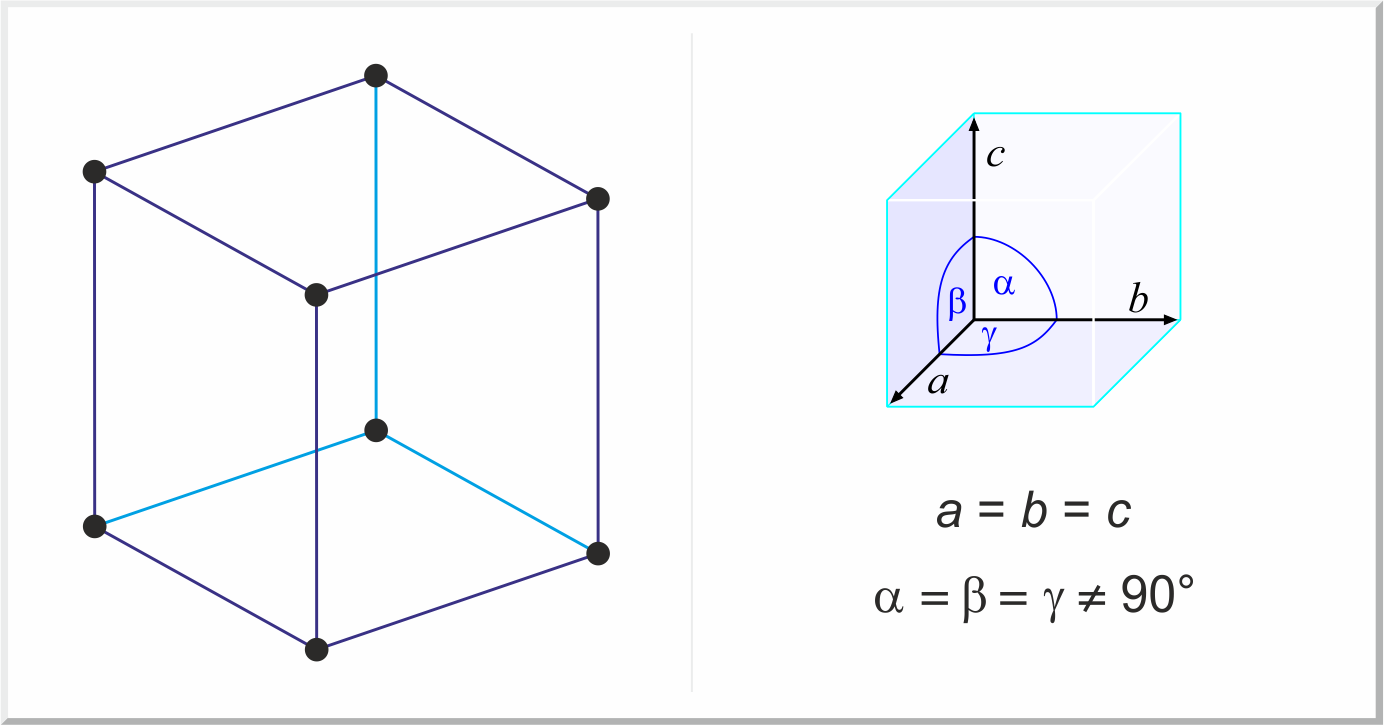
| Crystal structure: | rhombohedral |
| Unit-cell dimensions / pm: | a=454.950, c=1186.225 |
| Space group: | R3m |
| Isotope | Relative atomic mass | Mass percent (%) |
|---|---|---|
| 209Bi | 208.980 40(1) | 100 |
| Balanced half-reaction | Eo / V | |
|---|---|---|
| Bi3+ + 3e- → Bi(s) | +0.215 | |
| BiOH2+ + H+ + 3e- → Bi(s) + H2O | +0.254 | |
| BiO+ + 2H+ + 3e- → Bi(s) + H2O | +0.320 | |
| BiOCl(s) + 2H+ + 3e- → Bi(s) + H2O + Cl- | +0.160 | |
| Bi2O3(s) + 3H2O + 6e- → 2Bi(s) + 6OH- | - 0.46 | |
| Bi2O5(s) + 10H+ + 4e- → 2Bi3+ + 5H2O | +1.759 | |
| Bi2O5(s) + 8H+ + 4e- → 2BiOH2+ + 3H2O | +1.700 | |
| Bi2O5(s) + 6H+ + 4e- → 2BiO+ + 3H2O | +1.605 | |
| NaBiO3(s) + 4H+ + 2e- → BiO+ + Na+ + H2O | +1.80 | |
| BiCl4- + 3e- → Bi(s) + 4Cl- | +0.16 | |
| Bi(s) + 3H+ + 3e- → BiH3(g) | - 0.800 |
| 82 Lead | ← | 83 Bismuth | → | 84 Polonium |


Citing this page:
Generalic, Eni. "Bismuth." EniG. Periodic Table of the Elements. KTF-Split, 18 Jan. 2024. Web. {Date of access}. <https://www.periodni.com/bi.html>.


Copyright © 1998-2024 by Eni Generalic. All rights reserved. | Bibliography | Disclaimer