
COPPER
TRANSITION ELEMENT: COPPER GROUP
| Atomic number: | 29 |
| Group numbers: | 11 |
| Period: | 4 |
| Electronic configuration: | [Ar] 3d10 4s1 |
| Formal oxidation number: | +1 +2 |
| Electronegativities: | 1.9 |
| Atomic radius / pm: | 127.8 |
| Relative atomic mass: | 63.546(3) |
Copper has been known since ancient times. The origin of the name comes from the Latin word cuprum meaning the island of Cyprus famed for its copper mines. It is a malleable, ductile, reddish-brown metal, resistant to air and water. Exposed surfaces form greenish carbonate film. Pure copper occurs rarely in nature. It is usually found in sulfides as in chalcopyrite (CuFeS2), coveline (CuS), chalcosine (Cu2S) or oxides like cuprite (Cu2O). Copper is most often used as an electrical conductor and in the manufacture of water pipes. Its alloys are used in jewellery and for coins. The price of 99.9 % pure copper shot is 26.10 € for 500 g.
| Density / g dm-3: | 8960 | (293 K) |
| 7940 | (m.p.) | |
| Molar volume / cm3mol-1: | 7.09 | (293 K) |
| 8.00 | (m.p.) | |
| Electrical resistivity / µΩcm: | 1.673 | (20 °C) |
| Thermal conductivity / W m-1K-1: | 401 |
| Melting point / °C: | 1084.62 |
| Boiling point / °C: | 2562 |
| Heat of fusion / kJ mol-1: | 13 |
| Heat of vaporization / kJ mol-1: | 306.7 |
| Heat of atomization / kJ mol-1: | 337.15 |
| First ionization energy / kJ mol-1: | 745.49 |
| Second ionization energy / kJ mol-1: | 1957.93 |
| Third ionization energy / kJ mol-1: | 3554.64 |
| in the atmosphere / ppm: | - |
| in the Earth's crust / ppm: | 75 |
| in the oceans / ppm: | 0.003 |
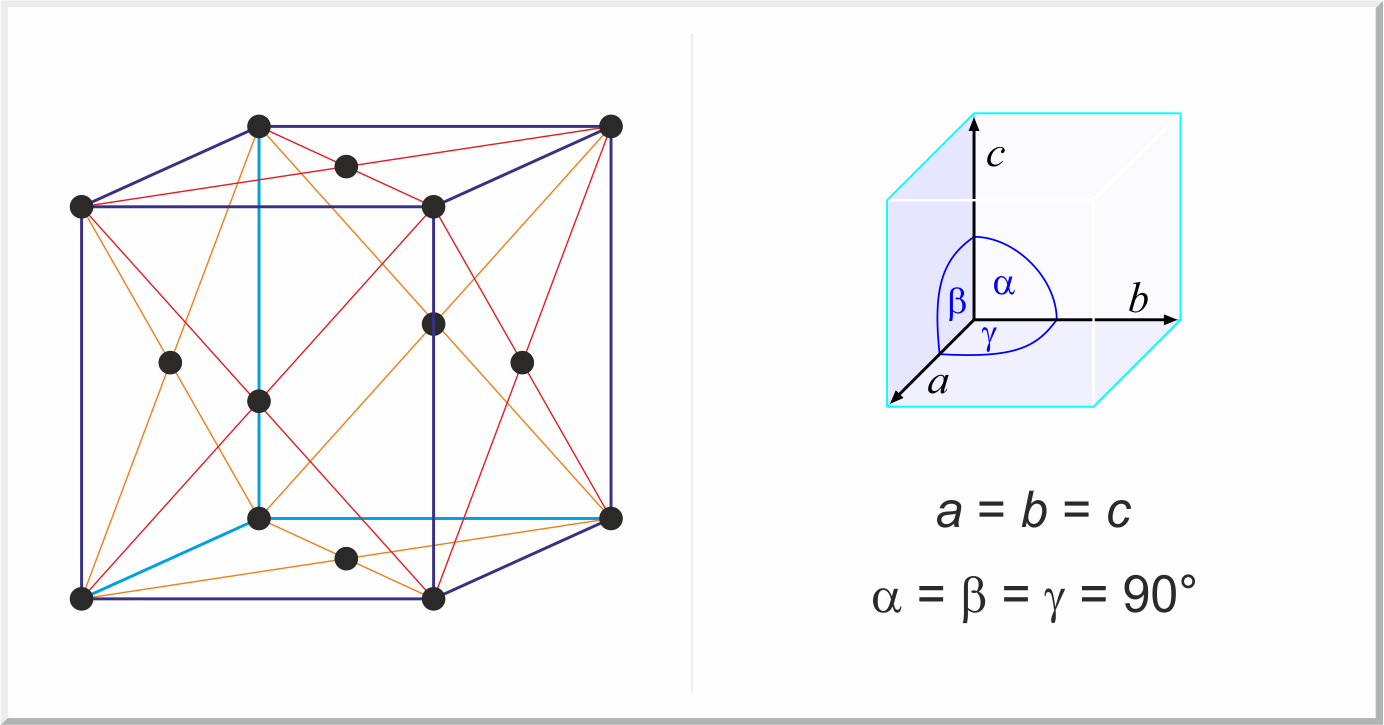
| Crystal structure: | face-centered cubic |
| Unit-cell dimensions / pm: | a=361.47 |
| Space group: | Fm3m |
| Isotope | Relative atomic mass | Mass percent (%) |
|---|---|---|
| 63Cu | 62.929601(2) | 69.17(3) |
| 65Cu | 64.927794(2) | 30.83(3) |
| Balanced half-reaction | Eo / V | |
|---|---|---|
| Cu2+ + 2e- → Cu(s) | +0.337 | |
| Cu2+ + e- → Cu+ | +0.153 | |
| Cu+ + e- → Cu(s) | +0.521 | |
| HCuO2- + 3H+ + e- → Cu+ + 2H2O | +1.73 | |
| CuO22- + 4H+ + e- → Cu+ + 2H2O | +2.51 | |
| HCuO2- + 3H+ + 2e- → Cu(s) + 2H2O | +1.13 | |
| CuO22- + 4H+ + 2e- → Cu(s) + 2H2O | +1.52 | |
| 2Cu2+ + H2O + 2e- → Cu2O(s) + 2H+ | +0.20 | |
| 2HCuO2- + 4H+ + 2e- → Cu2O(s) + 3H2O | +1.78 | |
| 2CuO22- + 6H+ + 2e- → Cu2O(s) + 3H2O | +2.56 | |
| CuO + 2H+ + e- → Cu+ + H2O | +0.62 | |
| Cu2+ + Br- + e- → CuBr(s) | +0.64 | |
| Cu2+ + Cl- + e- → CuCl(s) | +0.54 | |
| Cu2+ + I- + e- → CuI(s) | +0.86 | |
| CuI(s) + e- → Cu(s) + I- | - 0.185 | |
| Cu(NH3)42+ + e- → Cu(NH3)2+ + 2NH3 | - 0.01 | |
| Cu(NH3)2+ + e- → Cu(s) + 2NH3 | - 0.12 | |
| Cu(NH3)42+ + 2e- → Cu(s) + 4NH3 | - 0.07 |


Citing this page:
Generalic, Eni. "Copper." EniG. Periodic Table of the Elements. KTF-Split, 8 Feb. 2026. Web. {Date of access}. <https://www.periodni.com/cu.html>.


