
INDIUM
BORON GROUP
| Atomic number: | 49 |
| Group numbers: | 13 |
| Period: | 5 |
| Electronic configuration: | [Kr] 4d10 5s2 5p1 |
| Formal oxidation number: | +3 |
| Electronegativities: | 1.78 |
| Atomic radius / pm: | 162.6 |
| Relative atomic mass: | 114.818(1) |
Indium was discovered by Ferdinand Reich and Hieronymus Theodor Richter (DE) in 1863. Named after the indicum (colour indigo), the colour it shows in a spectroscope. It is a rare, very soft, silver-white metal that is stable in air and water but dissolves in acids. Metal can ignite and burn. Indium is found in certain zinc ores. It is used to coat high speed bearings and as an alloy that lowers the melting point of other metals. Relatively small amounts are used in dental items and in electronic semiconductors. The price of 99.9 % pure indium shot is 400.30 € for 250 g.
| Density / g dm-3: | 7310 | (298 K) |
| 7032 | (m.p.) | |
| Molar volume / cm3mol-1: | 15.71 | (298 K) |
| 16.33 | (m.p.) | |
| Electrical resistivity / µΩcm: | 8.37 | (20 °C) |
| Thermal conductivity / W m-1K-1: | 81.6 |
| Melting point / °C: | 156.6 |
| Boiling point / °C: | 2072 |
| Heat of fusion / kJ mol-1: | 3.27 |
| Heat of vaporization / kJ mol-1: | 231.8 |
| Heat of atomization / kJ mol-1: | 243.72 |
| First ionization energy / kJ mol-1: | 558.30 |
| Second ionization energy / kJ mol-1: | 1820.67 |
| Third ionization energy / kJ mol-1: | 2704.50 |
| in the atmosphere / ppm: | - |
| in the Earth's crust / ppm: | 0.05 |
| in the oceans / ppm: | 0.02 |
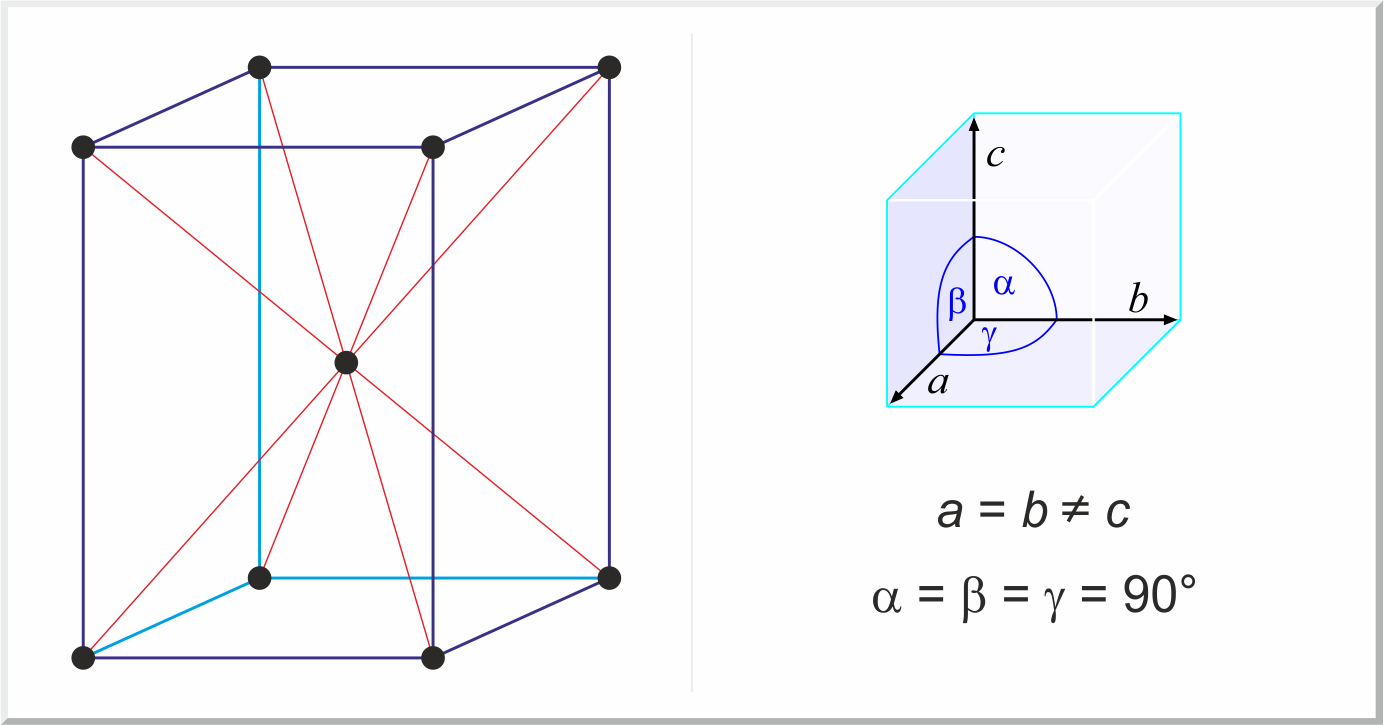
| Crystal structure: | body-centered tetragonal |
| Unit-cell dimensions / pm: | a=325.30, c=495.55 |
| Space group: | I4/mmm |
| Isotope | Relative atomic mass | Mass percent (%) |
|---|---|---|
| 113In | 112.904061(4) | 4.3(2) |
| 115In | 114.903878(5) | 95.7(2) |
| Balanced half-reaction | Eo / V | |
|---|---|---|
| In3+ + 2e- → In+ | - 0.404 | |
| In3+ + 3e- → In(s) | - 0.345 | |
| In(OH)3 + 3e- → In(s) + 3OH- | - 1.0 |
| 48 Cadmium | ← | 49 Indium | → | 50 Tin |


Citing this page:
Generalic, Eni. "Indium." EniG. Periodic Table of the Elements. KTF-Split, 8 Feb. 2026. Web. {Date of access}. <https://www.periodni.com/in.html>.


